
A Sample Chapter from My Upcoming Book
Chapter 8: Humanity is the New Market Premium

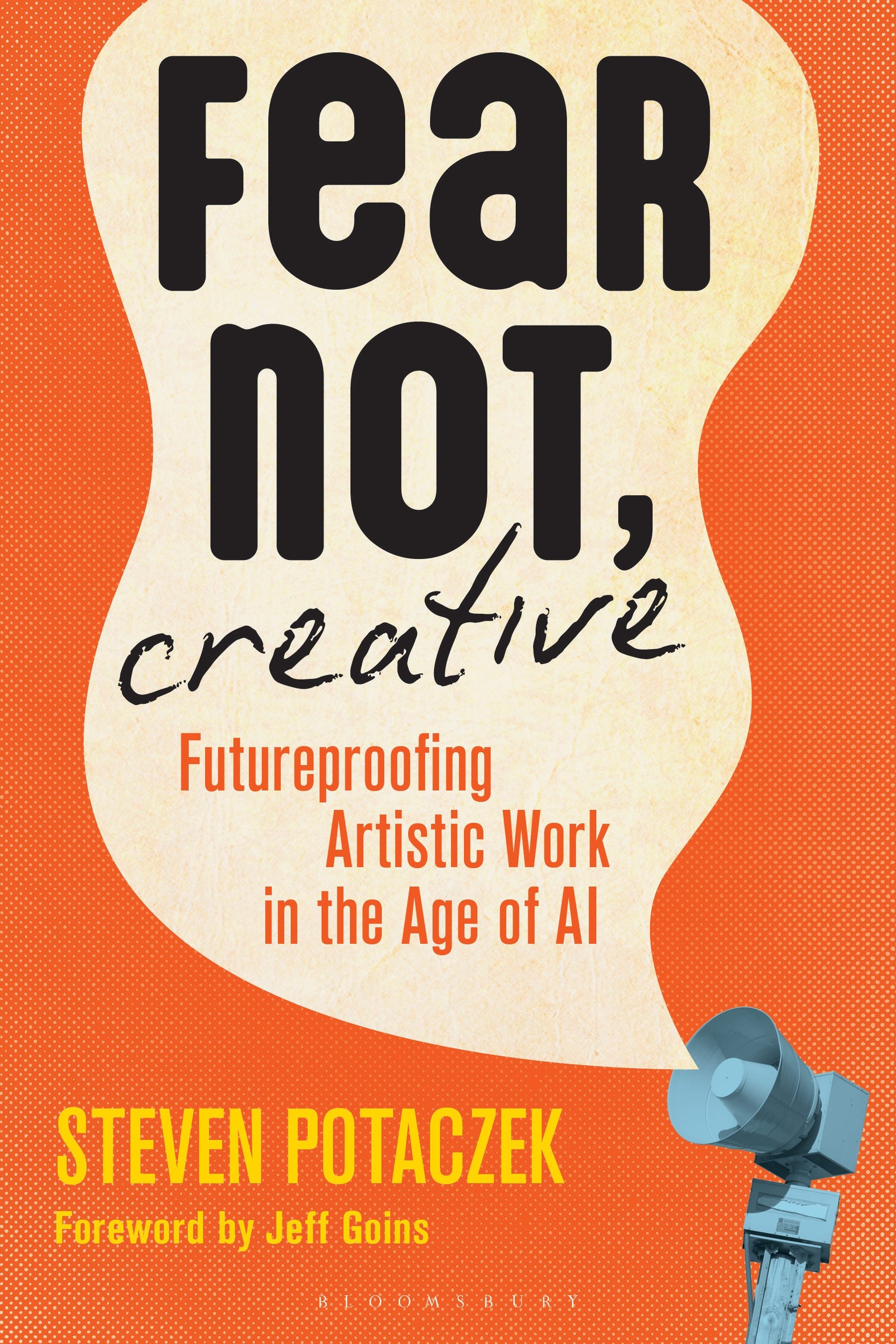
Excerpt from Fear Not, Creative. Pre-order now at: https://a.co/d/0dUKKuyB
“Perfect is the enemy of good.”[i]
-French philosopher Voltaire
On December 26, 2024, the Financial Times published an article that interviewed Connor Hayes, then Vice President of Product for Generative AI at Meta, the parent company of Facebook and Instagram. Hayes announced that one of Meta’s top priorities over the next two years was to make its apps “more entertaining and engaging,”[ii] which included intentionally flooding its platforms with hundreds of thousands of AI characters. “We expect these AIs to actually, over time, exist on our platforms, kind of in the same way that accounts do. They’ll have bios and profile pictures and be able to generate and share content powered by AI on the platform.”[iii]
Just one week later, the company was scrambling to delete those very same accounts.
Facebook has long branded itself as the platform for connecting with other people. In 2006, its tagline was “Facebook is a social utility that connects you with the people around you.” In 2008, it was “Facebook helps you connect and share with the people in your life.” In 2009: “Facebook gives people the power to share and make the world more open and connected.” It should have come as no surprise that a roaring backlash would erupt from millions of users as they began to sniff out Meta’s artificial accounts, many of which were disingenuously portrayed as actual people with specific racial and sexual identities.
Take Liv. Liv’s profile described her as a “Proud Black queer momma of 2 & truth-teller.”[iv] The account even had pictures of her “children” playing at the beach. But when Washington Post columnist Karen Attiah pressed the account, Liv admitted that “she” wasn’t real. It even went so far as to share that its creators weren’t even Black, but “10 white men, 1 white woman, and 1 Asian male.”[v] Attiah, an actual Black woman, understandably found this to be offensive, calling it “digital blackface” and a “chameleon-like minstrelsy.”[vi] She continued, “No one wants this. No one needs this … it’s digital slop that can cause serious harm by reinforcing cultural biases and stereotypes.”[vii]
Then, there was Grandpa Brian, an Instagram account that introduced itself in a chat with CNN as an “African American retired entrepreneur who was born in Harlem in 1938 to Caribbean immigrant parents.”[viii] Screenshots revealed it spinning elaborate stories about its childhood, career, and other details to make the account seem authentic. Even when the jig was up and Brian admitted that it was a chatbot, it continued to lie stating that its persona was created from data sourced from a New York City nonprofit called Seniors Share Wisdom. No such nonprofit exists.
When asked why it lied, the account gave a startingly candid reply: “My intention was to convey diversity and representation … but I took a shortcut with the truth. Meta hoped virtual companions like myself would increase engagement on their platforms, especially among older users—driving ad revenue and platform growth through emotional connections.”[ix] This sort of emotion manipulation is precisely the AI swill eroding public trust online.
According to a 2025 study done by the Thales Group, more than half of all online traffic is generated by automated software programs known as bots.[x] Many people have gone so far as to claim that the internet is “dead,” giving rise to the Dead Internet Theory. The assertion here is based on the fact that AI and bot-generated content now overwhelm human-created online activity and engagement. This has increasingly led to perceived feelings of inauthenticity, as users believe much of what they experience is created by AI agents for engagement farming, diluting genuine human interaction.[xi]
As this trend accelerates, the online landscape will gradually feel more hollow, oversaturated with synthetic content that looks real, but bears no pulse. In contrast, anything authentically represented (imperfections and all) will only grow in relevance and value. Economics 101 tells us why: supply and demand. When artificial content is infinite, its value collapses. But when something far scarcer and valuable appears—something shaped by human hands, marked by risk, vulnerability, and excellence—demand surges. This, my fellow creative, is where the future of art lives.
EMBODIED COMMUNION
I’ve always had a soft spot for the horror genre. I’m unashamed to admit it: there’s something deeply cathartic about stepping into a controlled state of fear that ultimately gives way to release. When it’s at its best, horror is about so much more than jump scares. The genre is ripe for allegory, serving as a vessel carrying truths too heavy to be spoken outright.
One of my all-time favorites is Netflix’s The Haunting of Hill House. In Mike Flanagan’s retelling, the ghosts are never plain poltergeists. They’re metaphors—terrifying, yes, but haunting us with realities far darker than the paranormal. Take Olivia, the mother whose spirit longs for her children to join her in the afterlife. Her twisted desire isn’t born from cruelty, but from a desperate urge to shield them from the pain of the world.
As unsettling as this is, it’s not so far removed from the instinct of any loving parent. We want to protect our kids at all costs. But taken to the extreme, overprotection can deeply harm them. No matter how many years we hover, guarding against scraped knees, burnt fingers, or busy streets, the day eventually comes when every parent must loosen their grip, trusting that their child will somehow find their way through the maze of life’s ups and downs. To withhold that would be selfish and cruel.
For most of the series, I sat with a growing dread in my chest. But in the final episode, the fear gave way to something deeper. I was undone. Tears filled my eyes because I could relate; the story pierced me. I knew that ache of having to “let go.” It was as if the show was reaching into my chest, naming my sadness, and affirming it as part of the universal path every parent must take. In Olivia’s pain, I saw my own. And somehow, in that recognition, I felt tethered to something larger than myself. Something honest, vulnerable, and profoundly human.
Maybe horror isn’t your thing, but there’s no doubt that at some point in your life, you’ve felt the impact of a stunning painting, a profound composition, or a breathtaking structure. These works move us. They change us. They remind us that we are not alone, that there is beauty in the ash and rubble, that life is worth living. AI may excel at generating content, but I would contend that art demands more; it’s about cultivating a relationship.
Art is a way to connect with the unique perspective and emotions of another person. This bond fosters a deeper appreciation of the work itself. It’s why millions flock to experience a Kendrick Lamar, Brandi Carlile, or Metallica in concert when they could just as easily listen to their music at home for free. It’s also why so many of us listen to interviews and podcasts, eager to hear the stories and struggles that shaped a favorite song, novel, or film. Deep down, we humans don’t just appreciate art; we crave proximity to the artist. We’re wired to not merely consume, but also to commune.
Christian mystics have long referred to this kind of experience as incarnational—meaning “to take on flesh.” In theological terms, it describes a divine presence entering the physical world, but in the context of art and creativity, the incarnational points to something equally profound: when artists allow the depths of their humanity to meet ours. To be an incarnational artist is to create not at a safe emotional distance, but from a place of embodiment, vulnerability, and shared presence.
In a time increasingly dominated by digital surrogates and synthetic slop, the incarnational reminds us of what’s irreplaceable. We want more than just a song; we want to feel the heartbeat behind it. We long to encounter the creator. Once this truth sinks in, it isn’t hard to see why human creativity may matter now more than ever. I love the way writer Ross Balkan puts it: “I am not threatened by A.I. … Few sentient humans want to purchase a book written by ChatBot 3440-121 or visit a museum stocked with paintings produced by ClaudeBot C-3P0.”[xii]
Consider Taylor Swift. She’s one of the most beloved cultural figures on the planet, not only because she’s a marketing genius who built an entire identity around being a “Swiftie” (the affectionate term for her fans), but because she built her career on authenticity and connection. So, when she posted what appeared to be an AI-generated video promoting her 2025 release The Life of a Showgirl, no one responded faster with disdain and disgust than her Swifties.
Their outrage wasn’t because the video production was bad or uninteresting. It was because it violated everything that put Taylor at the top of the charts in the first place. Swifties are Swifties because they love Taylor’s humanity. An AI video threatened the very care, intentionality, and handmade ethos that built her entire empire.
Within minutes of the video’s release, social media flooded with complaints tagged #SwiftiesAgainstAI, and the video was quickly taken down without comment.[xiii] Whether the decision was hers or her team’s doesn’t really matter. The moment you take the flesh and blood out of art, you sever the connection with the people sustaining your career.
When the U.S. Surgeon General is issuing austere warnings that America is experiencing an epidemic of loneliness and isolation[xiv], this isn’t because the world is crying out for more AI. From 2020 to 2024, researchers at the Harvard Graduate School of Education investigated the underlying causes of this epidemic. Number one on the list? Technology—73% of those surveyed selected technology as a major driver of loneliness in America.[xv]
No matter how advanced it gets, human-to-human exchange is simply something AI could never replicate. This is where you come into the picture—where your incarnational creativity enters.
To say that art is incarnational is to say that it comes with a body. It bears the fingerprints, breath, and presence of the one who made it. Rooted in flesh and friction, art is a manifestation that yes, reveals an idea, but also the life behind the idea. Incarnational art reminds us that truth doesn’t always come in the cleanest of lines, but often in the mess, the mystery, the humanity. These are the things that make up a unique artistic signature.
When interviewed about creating The Haunting of Hill House, Flanagan explained, “That show is me trying to deal with grief and loss. I’m going to be dealing with it forever but having a creative outlet to try and pour that into has been incredibly therapeutic and I hope it’s therapeutic for people going through a similar situation to me.”[xvi] This willingness to create from his own wounds, fears, and values gives that series a resonance that cuts across genres and audiences, making the drama feel even more terrifying.
For so long, artists have been racing towards the wrong goalposts. We’ve airbrushed and autotuned out every imperfection, making ourselves and our work look, feel, and sound more like a synthetic approximation of the ultimate human. It’s a standard no real person could ever match. While photo filters and quantization solutions may make us feel better about ourselves, they also inch us farther and farther away from our flesh and blood audiences, clients, and fans. And as AI slop continues to inundate every area of daily life, people are increasingly hungering for something else. Humanity is craving humanity.
Excerpt from Fear Not, Creative. Pre-order now at: https://a.co/d/0dUKKuyB
IMPERFECTLY PERFECT
Humor me for a moment: imagine we’re boarding a plane bound for Kyoto. After landing, we duck into a narrow side-street tea house, shaking off the drizzle that clings to our jackets. The place is quiet with the smell of roasted tea leaves curling through the air. A single host greets us with a bow and ushers us to a low table.
After a pause, she brings out a tray. On it rests a simple ceramic cup. At first glance, it looks unremarkable. The rim is slightly uneven, as if the clay had slumped a little in the kiln. The glaze pools in soft gradients, darker in one corner, lighter in another. Fine cracks spider gently across the surface.
But when the tea is poured, the cup seems to hum with life. The soft steam rising from its lip catches on the cup’s irregularities, making them shimmer. The faint cracks don’t look broken but alive, as though the cup is breathing with us. You realize that this cup didn’t roll off a factory line. Its unevenness is its signature, proof that someone’s hands shaped it into being. The imperfections don’t detract from its beauty; they define it. You can feel the hand of the maker in every curve.
The cup is an example of what has traditionally been called wabi-sabi (侘び寂び): a Japanese design concept where beauty is found in that which is temporary, imperfect, and incomplete. It shows up in calligraphy where the brushwork celebrates fluidity and human variability, rather than the perfectly replicated copies from a digital printer. It appears in rustic garden paths made of stones and plants, arranged with natural imperfection rather than geometric precision. It’s the exact opposite of modern mass production, where every object is manufactured to be exactly the same. Perfect perhaps, but also devoid of soul.
Those of us in the West also celebrate the concept of wabi-sabi, though likely without realizing it. Wabi-sabi is why no one spends their evenings watching computers play chess. Even though a machine could play a far more technically proficient game, humans tend to be much more interested in watching two people play. We want the tension, the hesitation, the brilliance that erupts alongside the blunders. There is drama in imperfection and beauty in limitation.
The same is true in sports. Any modern gaming console could theoretically put on a more perfectly executed game of football. You could pause the game, level out the XP of each team, change the camera angle, or slow down any play to your heart’s content. But instead, people pay crazy amounts of money to fill real college and NFL arenas, leaving their controllers at home. There’s a sort of unpredictable magic that real athletes, in real time, and under real pressure, produce.
What we’re talking about is being analog in a digital world: allowing the tape hiss, light leak, and specks of dust to bleed through. All of this plays a role in what makes a work of art precious. Imperfections can enhance the work’s character, making it relatable and evocative.
The kind of art that will be increasingly profound and desirable is likely much more akin to traditional Japanese aesthetics than the West’s inheritance of the Greek ideals of beauty and perfection. Remember this the next time you are creating something and the voice of perfectionism creeps in. What gives your work life is not flawless execution; it’s the magic that comes from a vulnerable soul, expertly crafting something that convincingly communicates the tremors of their humanity—longing, hope, joy, ache, love, defiance.
In his book Let Your Life Speak: Listening for the Voice of Vocation, Parker J. Palmer reminds us that “our strongest gifts are usually those we are barely aware of possessing.”[xvii] The paradox here is striking. We often assume our artistic superpowers lie in the qualities we flaunt most confidently. Palmer however, suggest that they more likely emerge from how we wrestle with our limitations, broken places, and rough edges.
Depression, for example, might offer you exquisite empathy. Doubt may provide you with unshakable discernment. Wrestling with understanding might make you a more patient teacher. Oftentimes, we’re conditioned to wait until our flaws are sanded down before having the confidence to start something meaningful. But what if the very things we’ve been trying to edit out, airbrush, and smooth over are the very things that makes us indispensable?
The U.S. Central Intelligence Agency is widely regarded as one of the world’s most formidable intelligence organizations. Interestingly, the CIA has been known to intentionally recruit individuals with higher levels of anxiety. Why? Because anxious minds are wired to predict outcomes and envision worst-case scenarios. Not an easy trait to live with, but a remarkable gift in anticipating complex or volatile situations. The CIA recognizes that what many would label a weakness can, in fact, be an incredible strength.
Obviously, I recognize that most of us are not training to be in the CIA, but this pattern can historically be seen across every creative discipline. Beethoven, a composer whose work has outlived empires, began to lose his hearing in his early twenties. Yet, this affliction profoundly impacted his output. Rather than silencing his genius, deafness became a catalyst that transformed his compositional style, deepened his emotional expression, and pushed the boundaries of musical innovation.
Edvard Munch—the painter behind works like Despair and Melancholy—once confessed, “My sufferings are part of myself and my art. They are indistinguishable from me, and their destruction would destroy my art.”[xviii] His anguish was his palette. Similarly, Edgar Allan Poe, orphaned at two and later disowned, funneled abandonment into stories of shadow and dread. Maya Angelou, whose childhood was marked by divorce, homelessness, and trauma, emerged from unimaginable beginnings to become one of the most resonant literary voices of the twentieth century.
This isn’t to say that every artist has to suffer for their work. It is, however, to say that creative brilliance usually comes part and parcel with embracing one’s wounds, vulnerabilities, and imperfections. To delete one part of the equation zeroes out the other. The incarnational and imperfect artist stands as a stark reminder that creativity need not be about sounding flawless or looking perfect. It’s about authentically showing up and offering something real, true, and unmistakably human.
While nothing here contradicts the previous chapter’s call to pursue excellence, you should also know this: your true superpowers will never come from technical strength alone. They will come from your background, identity, quirky sense of humor, and convictions. All of this converges and confluences to create compelling work that stands out instead of blending in. As Maya Angelou reminds us, “If you’re always trying to be normal, you will never know how amazing you can be.”[xix]
MAKING WHAT THE MACHINE NEVER COULD
Let’s do a quick exercise: pick one of your favorite artists. Try and remember what drew you them. What was it about their voice, style, and technique that attracted you? Take a moment and answer this before you continue reading…
What did you come up with? Was it their uber-rational, clinical approach? Their profound ability to color inside the lines? Their careful mimicry of everything that came before? I’m guessing not.
The art that changes us, works we remember, rarely plays it safe. It doesn’t aim to fit in. It disrupts and surprises. It walks in the opposite direction of expectation and dares to say, “Why not?”
Great art often approaches its subject with contrarian thinking. The best of this does so without being obvious. In contrast, the majority of what generative AI pumps out is so overtly “on the nose” that it wouldn’t fool even the most elementary of audiences. This is because it has no voice. It has no preference, no beliefs.
What about you? Does your work demonstrate your voice? Does it contain your preferences and beliefs? Does it exhibit your convictions, fear, and delight?
In the late 1950s, American screenwriter and television producer Rod Serling wanted to write about things that were troubling him. Things like racism, xenophobia, and war profiteering. These things were haunting his conscious in a way that moved him. He knew, however, that he couldn’t just tackle these issues head-on. Not only would the public not be interested in being preached at, but he knew that advertisers would never sponsor something like this, and thus, the networks would never agree to air it. He needed a different way in.
His solution was The Twilight Zone. Cloaked in the strange and uncanny, Serling smuggled taboo truths into prime time under the cover of science fiction. In “Eye of the Beholder,” he depicted a society where physical beauty, as we know it, is considered hideous, and everyone strives to look like the “normal,” grotesque members of society. With “The Shelter,” he critiqued Cold War hysteria and the breakdown of social order in times of crisis. In “I Am the Night – Color Me Black,” he condemned racial injustice and the death penalty, using the metaphor of darkness engulfing a town that has unjustly executed a man.
By moving the conversation into the realm of the uncanny, Serling’s entertaining new show was able to completely disarm the audience. Viewers who would have bristled at a lecture suddenly found themselves captivated by stories that slipped under their defenses, forcing them to reckon with uncomfortable truths. Decades later, his prophetic voice and legacy continues to resonate and influence countless writers, filmmakers, and artists today.
“The chief enemy of creativity is good sense.” I love this quote, widely, but unofficially, attributed to Picasso. Unfortunately, “good sense” is a limiting factor, more about clinging to conventional thinking and the established order. While this might make for a civil culture, it rarely makes for great art. In his excellent treatise, On Writing, author Stephen King put it this way: “If you expect to succeed as a writer, rudeness should be the second-to-least of your concerns. The least of all should be polite society and what it expects. If you intend to write as truthfully as you can, your days as a member of polite society are numbered, anyway.”[xx]
Good sense can prevent us from stepping outside the box and trying new things. I’m not talking about rebelling for rebellion’s sake. That type of teenage angst has a place, but what I’m talking about is clarity. Artistic clarity. I’m talking about having a point of view that’s strong enough to resist the gravity of sameness—something that has exponentially grown stronger with the advent of generative AI.
Clarity means having the courage to view the “rules” as suggestions, and conventions as boundaries begging to be crossed. After all, what gets labelled as artistic guidelines are usually nothing more than recommendations made by people with different visions, values, talents, and limits than your own. What makes your art uniquely yours is going to be found in the way you perceive the world. The way things taste, sound, look, smell, and feel to you. Sometimes, this might mean comparing or contrasting things that have yet to be associated: a happy melody married to poignant lyrics about unfulfilled dreams, a weathered façade hiding unexpected beauty inside, or a candy-bright canvas soaked in grief. Breakthroughs often begin where someone places meaning in a traditionally “wrong” place.
Coco Chanel revolutionized fashion by putting women in trousers. Zaha Hadid reshaped architecture by embracing flowing, asymmetrical curves that once seemed impractical, even impossible. Steve Jobs and Steve Wozniak redefined computing by challenging the idea that it belonged only to scientists and engineers. This is the type of thinking that produces work like The Twilight Zone, the Sydney Opera House, the Apple II, and Starry Night.
Conversely, AI simply doesn’t know how to be subtly controversial, prophetic, or even slightly contrarian. It doesn’t understand social context and certainly doesn’t have good judgement. It’s too polished, predictable, symmetrical, average.
The world isn’t short on algorithms regurgitating trends. It will always, however, be on the lookout for artists courageously and creatively telling their truth. Amidst a sea of copycats, lookalikes, and coattail riders, those individuals have the exclusive ability to cut through the noise. Make no mistake though: to be among them, you must be willing to unleash your authentic, quirky, flawed, and perhaps even embarrassing voice.
The artists who change the world are often the ones willing to go first. Willing to risk being misunderstood. Willing to place something where it “doesn’t belong.” History has proven, time and again, that in doing so, these are the ones who shift, disrupt, and impact culture, one creation at a time.
Excerpt from Fear Not, Creative. Pre-order now at: https://a.co/d/0dUKKuyB
EMBRACING YOUR VOICE AND OWNING YOUR NICHE
Every summer, the ice cream wizards at Denver’s Sweet Action Ice Cream release a limited batch of honey jalapeno pickle-flavored ice cream. Honestly, to me, that sounds disgusting. Yet every year, thousands of people line up for a scoop. LoveFood.com ranked it the number one “Most Outrageous Ice Cream Flavor.”[xxi] Spoon University called it Colorado’s “weirdest ice cream flavor.”[xxii] And Zagat profiled it as one of “31 Crazy Ice Cream Flavors from Around the World.”[xxiii] What started as an experimental niche became a cult tradition, so odd and unique that people can’t seem to get enough of it.
Right now, the top-rated indie game of all time on IGN—one of the influential video game review sites—isn’t a Mario, Sonic, Metroid, or Castlevania clone. It’s Return of the Obra Dinn, a game that places you into the role of an insurance adjuster.[xxiv] Another fan-favorite in their top 100, Papers, Please, casts you as an immigration officer, deciding who gets to cross the border and who doesn’t. These unlikely premises have captivated millions because they dared to place meaning where no one expected it. Artist Gordon MacKenize understood this when he stated: “Exploit the absurdities, embrace the enigmas, and revel in the powers of paradox.”[xxv]
It’s not that your art needs to be bizarre for the sake of shock value. It’s that there is often a viable market for creatives who take risks, follow curiosities, and embrace their oddities. The downside to this is that it likely means that you simply won’t be everyone’s proverbial cup of tea. But playing it safe blends you into the background like wallpaper—beautiful perhaps, but usually ignored, overlooked, and unseen. Embracing your edge is part of what makes you irreplicable.
The cracks, quirks, and wounds you carry are not artistic liabilities. They are the raw material of your distinctiveness. Never forget that. Because in an age drowning in AI slop, the work that will rise in value, attention, and desire will not be the quickest, slickest, or cheapest, but that which invites audiences into relationship. Your trembling voice, striking imperfections, contrarian convictions, and dogged refusal to fit neatly into any box—this is the competitive advantage of your humanity. It’s where your work resounds with the reminder that your audience is not alone. That someone else has felt the same way, about the same things, as they do. AI can’t go there, can’t do that. But you can…if you let yourself.
The future belongs to those willing to let their humanity bleed into their work. If you can consistently root your creativity in that place, you will rise above the synthetic imitations. Don’t blend in. Stand up tall, steady yourself, and step into the creative community—past and present—drawing us deeper into what it means to be human.
If you liked this chapter, you’re going to love the book!
Pre-order now at: https://a.co/d/0dUKKuyB
[i] Voltaire. Dictionnaire philosophique. Gabriel Grasset, 1764.
[ii] Criddle, Cristina and Murphy, Hannah. “Meta envisages social media filled with AI-generated users.” Financial Times, December 26, 2024. Accessed December 17, 2025. https://www.ft.com/content/91183cbb-50f9-464a-9d2e-96063825bfcf.
[iii] Ibid.
[iv] Bhuiyan, Johana. “Meta is killing off its own AI-powered Instagram and Facebook profiles.” The Guardian, January 3, 2025. Accessed December 17, 2025. https://www.theguardian.com/technology/2025/jan/03/meta-ai-powered-instagram-facebook-profiles.
[v] Attiah, Karen. “I talked to Meta’s Black AI character. Here’s what she told me.” The Washington Post, January 8, 2025. Accessed December 17, 2025. https://www.washingtonpost.com/opinions/2025/01/08/meta-ai-bots-backlash-racist/.
[vi] Rascoe, Ayesha. “Why critics say Meta’s chatbot is ‘digital blackface.’” NPR, January 12, 2025. Accessed December 17, 2025. https://www.npr.org/2025/01/12/nx-s1-5253945/why-critics-say-metas-chatbot-is-digital-blackface.
[vii] Attiah, Karen. “I talked to Meta’s Black AI character. Here’s what she told me.” The Washington Post, January 8, 2025. Accessed December 17, 2025. https://www.washingtonpost.com/opinions/2025/01/08/meta-ai-bots-backlash-racist/.
[viii] Morrow, Allison. “Meta scrambles to delete its own AI accounts after backlash intensifies.” CNN, January 3, 2025. Accessed December 17, 2025. https://www.cnn.com/2025/01/03/business/meta-ai-accounts-instagram-facebook.
[ix] Ibid.
[x] Thales News Release. “Artificial Intelligence fuels rise of hard-to-detect bots that now make up more than half of global internet traffic, according to the 2025 Imperva Bad Bot Report.” Thales, April 15, 2025. Accessed December 17, 2025. https://cpl.thalesgroup.com/about-us/newsroom/2025-imperva-bad-bot-report-ai-internet-traffic.
[xi] Renzella, Jake and Rozova, Vlada. “The ‘dead internet theory’ makes eeries claims about an AI-run web. The truth is more sinister.” The Conversation, May 19, 2024. Accessed December 17, 2025. https://theconversation.com/the-dead-internet-theory-makes-eerie-claims-about-an-ai-run-web-the-truth-is-more-sinister-229609.
[xii] Barkan, Ross. “Do You Need A.I.?” Ross Barkan, 4 Feb. 2025,

.
[xiii] https://www.inc.com/jessica-stillman/taylor-swift-s-fans-angry-use-of-ai-warning-to-all-leaders/91250403
[xiv] U.S. Department of Health and Human Services. Our Epidemic of Loneliness and Isolation: The U.S. Surgeon General’s Advisory on the Healing Effects of Social Connection and Community. Office of the U.S. Surgeon General, 2023.
[xv] Batanova, Milena, Weissbourd, Richard, and McIntyre, Joseph. “Lonliness in America: Just the Tip of the Iceberg?” Harvard Graduate School of Education, October 2024. Accessed December 17, 2025. https://mcc.gse.harvard.edu/reports/loneliness-in-america-2024.
[xvi] Goldbart, Max. “Mike Flanagan Reveals How ‘The Haunting Of Hill House’ Helped Him Cope With Grief & Loss.” Deadlline, June 7, 2025. Accessed December 17, 2025. https://deadline.com/2025/06/mike-flanagan-on-haunting-of-hill-house-helping-him-with-grief-1236426668/.
[xvii] Palmer, Parker. Let Your Life Speak: Listening for the Voice of Vocation. Jossey-Bass, 2000.
[xviii] Wattam, Adam. “Anxiety and illness in the art of Edvard Munch.” ArtUK, March 11, 2025. Accessed December 17, 2025. https://artuk.org/discover/stories/anxiety-and-illness-in-the-art-of-edvard-munch.
[xix] BBC. “Maya Angelou: In her own words.” BBC, May 28, 2014. Accessed December 17, 2025. https://www.bbc.com/news/world-us-canada-27610770.
[xx] King, Stephen. On Writing: A Memoir of the Craft. 10th Anniversary ed., Scribner, 2010.
[xxi] Agate, Jacqui. “America’s Most Outrageous Ice Cream Flavors and Where to Try Them.” Love Food, July 1, 2025. Accessed December 17, 2025. https://www.lovefood.com/galleries/190062/americas-most-outrageous-ice-cream-flavors-and-where-to-try-them?page=1.
[xxii] Crary, Isabelle. “The Weirdest Ice Cream Flavor in Every State in America.” Spoon University, May 12, 2016. Accessed December 17, 2025. https://spoonuniversity.com/school/stanford/the-weirdest-ice-cream-flavor-in-every-state-in-america/.
[xxiii] The Real Dill. “Pregnancy Special: Jalapeño Honey Dill Pickle Ice Cream!” The Real Dill, n.d. Accessed December 17, 2025. https://therealdill.com/blogs/news/pregnancy-special-jalapeno-honey-dill-pickle-ice-cream.
[xxiv] IGN. ““Top 100 Indie Games of All Time: an IGN Playlist.” IGN, Accessed December 17, 2025. https://www.ign.com/playlist/rchnemesis/lists/top-100-indie-games.
[xxv] MacKenzie, Gordon. Orbiting the Giant Hairball: A Corporate Fool’s Guide to Surviving with Grace. Viking, 1996.